
October 05, 2026
Mortgage Rates: Waiting for the Break
Mortgage rates have been stubborn lately. Just when the market gives us a little hope, rates seem to turn around and head the other direction.
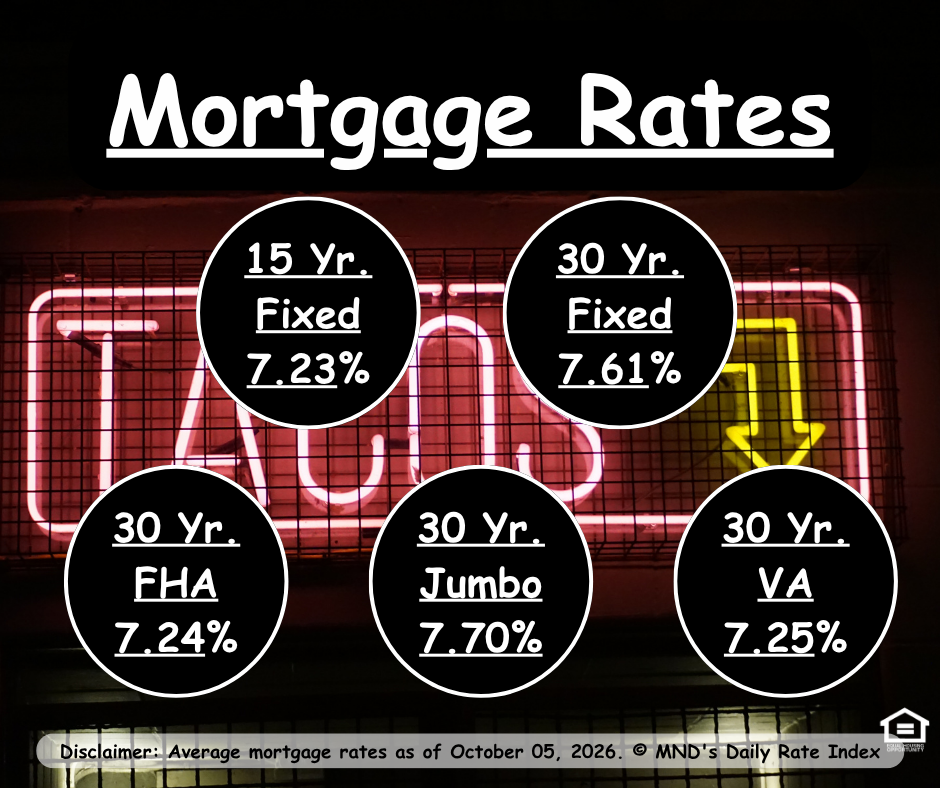
According to Mortgage News Daily, the average top-tier 30-year fixed mortgage rate finished Monday, October 5 at 7.61%, compared with 7.57% Friday and 7.43% on September 25.
So what’s keeping rates elevated — and what could finally give us some relief?
Let’s Taco ’Bout it. 🌮
📈 Where Mortgage Rates Are Right Now
Mortgage rates have moved noticeably higher over the past couple of weeks.
Mortgage News Daily’s 30-year fixed index:
September 25: 7.43%
September 28: 7.50%
September 29: 7.58%
September 30: 7.60%
October 1: 7.54%
October 2: 7.57%
October 5: 7.61%
That puts MND’s benchmark rate at one of its highest recent levels.
Remember: these are national benchmark rates for a specific top-tier borrower scenario. Your actual mortgage rate depends on factors including credit score, loan program, down payment, occupancy, property type and pricing available through the lender.
💼 Wait… Didn’t We Just Get a Weak Jobs Report?
Yep. And this is where things get interesting.
Friday’s employment report showed only 29,000 jobs added versus 90,000 expected. Initially, bonds liked the news. Mortgage-backed securities improved, and the 10-year Treasury yield dropped.
Normally, weaker employment data can be good news for mortgage rates because it suggests the economy may be cooling.
But the rally didn’t last.
Mortgage News Daily noted that the unemployment rate only edged from roughly 4.1% to 4.2%, while underlying details of the report suggested the labor market wasn’t necessarily deteriorating as dramatically as the headline payroll number suggested. Bonds eventually gave back their early gains, and mortgage rates finished Friday higher.
Translation?
One weak number wasn't enough to convince the bond market that the economy is truly slowing.
🏦 Why Aren’t Mortgage Rates Coming Down?
There isn’t one single villain we can blame.
Mortgage News Daily points to several forces currently creating pressure in the bond market, including inflation concerns, heavy Treasury issuance, strong stock markets competing for investor dollars, resilient economic data and uncertainty surrounding Federal Reserve policy.
And this matters because mortgage rates aren't directly controlled by the Federal Reserve.
Mortgage rates are heavily influenced by the bond market — particularly mortgage-backed securities — along with movements in Treasury yields.
When investors sell bonds, bond prices fall and yields rise.
That generally creates upward pressure on mortgage rates.
When investors buy bonds, prices rise and yields fall.
That can create room for mortgage rates to improve.
👀 What Am I Watching Next?
Right now, I’m watching the bond market for signs that investors finally have a reason to start buying again.
That could come from softer economic data, easing inflation pressure, changes in expectations for the Federal Reserve or simply a broader shift in investor sentiment.
The important thing to understand is that markets don't always move the way we expect based on one report.
Friday was a perfect example.
Weak jobs data initially helped bonds — but by the end of the day, the improvement disappeared and mortgage rates actually finished higher.
That’s why trying to perfectly time the bottom in mortgage rates can be tricky.
🐼 What Does This Mean for Buyers?
If you're waiting for mortgage rates to magically drop before buying a home, I wouldn't make that your entire strategy.
Instead, let's look at the whole picture:
Your purchase price.
Your monthly payment.
Seller concessions.
Temporary buydowns.
Different loan programs.
Your expected time in the home.
And yes — your mortgage rate.
Sometimes the better opportunity isn't finding the lowest rate on the internet. It's structuring the financing around your specific situation.
And if rates improve later?
We can always look at whether refinancing makes sense.
Marry the house. Date the rate. But definitely run the numbers before you commit to either one. 😉
❓ Mortgage Rate FAQs
Are mortgage rates expected to come down?
Mortgage rates can improve if inflation continues cooling, economic data weakens or bond investors become more confident that Federal Reserve policy can become less restrictive. But rate movement is rarely a straight line, and short-term volatility should be expected.
Does the Federal Reserve set mortgage rates?
No. The Federal Reserve directly controls the federal funds rate, not mortgage rates. Mortgage rates are more closely connected to the bond market and mortgage-backed securities, although Fed policy and expectations can strongly influence those markets.
Why can mortgage rates rise after weak economic data?
Markets react to much more than one headline number. Investors look at the details of economic reports, inflation expectations, Federal Reserve policy, Treasury supply and other global and financial-market factors.
Should I wait for mortgage rates to fall before buying?
Not necessarily. A lower rate can improve affordability, but home prices, competition, seller concessions and your personal financial situation also matter. Running scenarios can help determine whether buying now or waiting makes more sense for you.
Can I refinance if mortgage rates fall later?
Potentially, yes. If rates fall enough and you qualify, refinancing may reduce your payment or provide other financial benefits. The costs of refinancing should always be compared with the expected savings.
🐼 The Bottom Line
Mortgage rates aren't giving buyers much love right now, but that doesn't mean there aren't opportunities.
The market is waiting for convincing evidence that inflation and economic growth are cooling enough to give bonds a reason to rally.
Until then, expect some bumps.
If you're buying, selling or just trying to figure out whether today's numbers make sense for you, don't try to solve the mortgage puzzle with a national headline rate.
Let me run the numbers based on your situation.
I have access to 50+ lenders and loan options for borrowers in 49 states, so there may be strategies available that you haven't considered.
Ready to Taco ’Bout your options? Complete the form below and let's run the numbers.
Mortgage rate information referenced from Mortgage News Daily as of October 5, 2026. Rates shown are national benchmark rates and are not a rate quote or offer to lend. Individual rates and terms vary based on borrower and loan characteristics.

